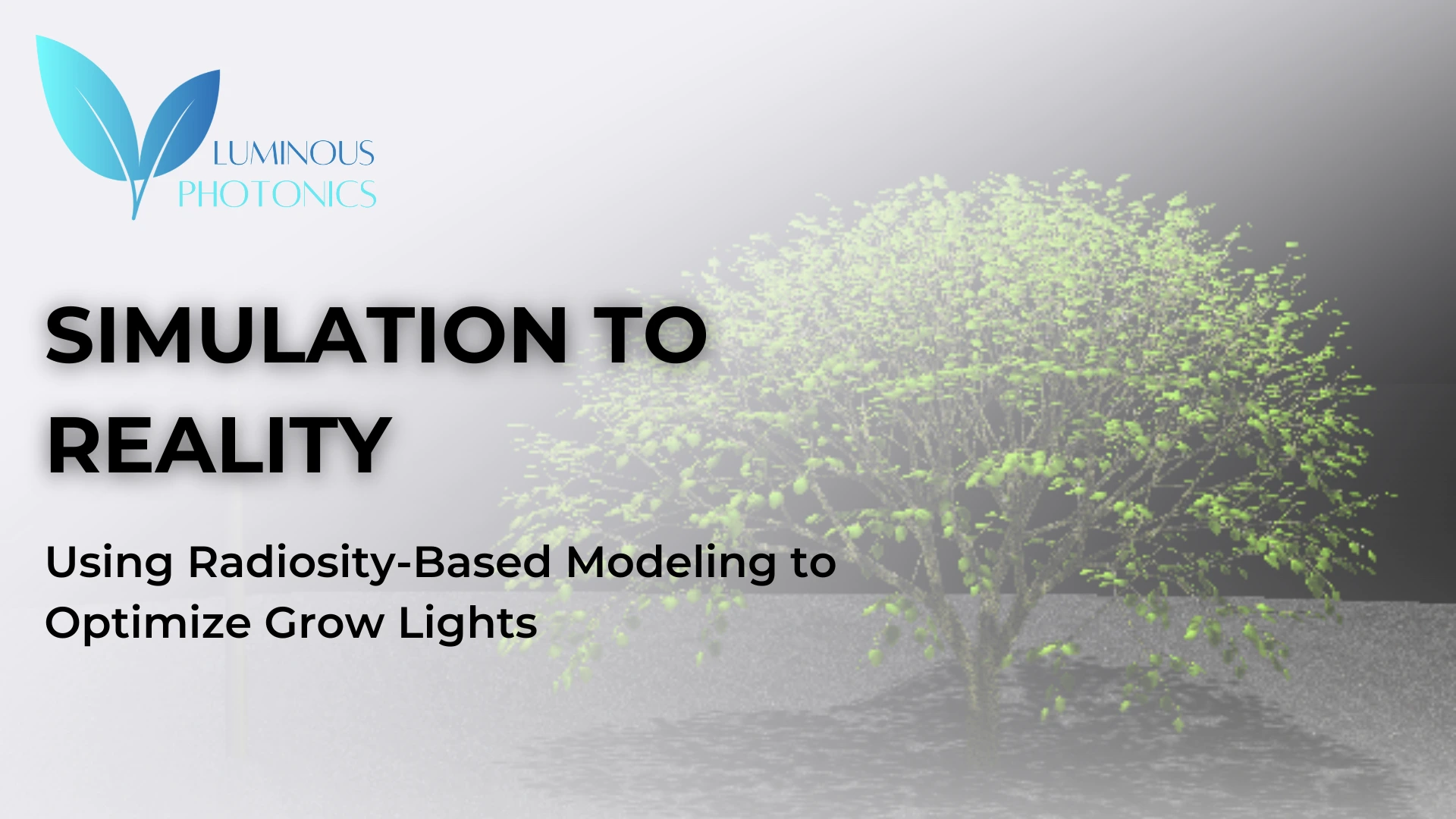
From Simulation to Reality: Using Radiance-Based Modeling to Optimize Grow Lights
How Radiance-Based Modeling is Revolutionizing Grow Light Efficiency and Energy Optimization
Horticultural lighting is undergoing a transformation as growers seek more precise, efficient, and cost-effective ways to optimize plant growth. One of the most powerful tools aiding this revolution is Radiance-based modeling—a simulation technique that provides a highly accurate prediction of how light behaves within a controlled environment. By using advanced lighting simulations, growers can fine-tune their lighting setups to maximize Photosynthetic Photon Flux Density (PPFD) uniformity, energy efficiency, and overall crop yield.
What is Radiance-Based Modeling?
Radiance is the gold standard in lighting simulation software, a physics-based lighting simulation method that utilizes the ray-tracing technique to simulate how light is emitted, reflected, and absorbed within a space. Unlike simple direct lighting calculations, Radiance takes into account interreflections, ensuring a more realistic representation of light distribution across plants.
In horticulture, Radiance modeling helps answer crucial questions:
- Where should lights be placed for maximum PPFD uniformity?
- How does light interact with reflective surfaces within a greenhouse or indoor farm?
- What is the most energy-efficient way to achieve optimal light coverage?
How Radiance Modeling Improves Horticultural Lighting
By integrating Radiance models into LED grow light optimization, growers can achieve several advantages:
1. Achieving Superior PPFD Uniformity
Traditional grow lights often create hot spots and dark zones, leading to uneven plant growth.
Radiance-based simulations calculate light distribution across an entire canopy, allowing growers to design high-uniformity lighting setups.
2. Reducing Energy Waste
Poorly positioned lighting leads to overlapping beams and wasted energy.
Simulations identify the ideal placement and intensity levels to minimize power consumption while maintaining effective illumination.
3. Optimizing Reflectance and Light Utilization
Indoor farms often use reflective surfaces to bounce light back toward plants.
Radiance models factor in reflectance properties, ensuring light is redirected efficiently rather than being lost.
4. Customizing Lighting Designs for Different Crops
Different plants have varying light requirements at each growth stage.
Using Radiance, growers can design customized light distributions for specific crops, ensuring optimal spectral coverage and intensity.
The Role of AI in Enhancing Radiance-Based Optimization
Machine learning and AI-driven optimization algorithms are taking Radiance modeling to the next level. By integrating AI with Radiance simulations, lighting systems can be dynamically adjusted in real time based on plant feedback. This ensures:
- Adaptive lighting control for different growth phases
- Automated adjustments to maintain uniformity as plants grow
- Further energy savings by optimizing light output only when necessary
The Future of Grow Light Simulation
With advancements in computational modeling and cloud-based AI analysis, Radiance-driven horticultural lighting systems are becoming more accessible. Future developments will likely integrate:
- Real-time IoT sensor feedback to dynamically update lighting conditions
- Hybrid AI and Radiance models for even better efficiency
- Fully automated lighting control systems for greenhouse and vertical farming operations
Conclusion
Radiance-based modeling is bridging the gap between simulation and real-world agricultural efficiency. By leveraging this advanced lighting technology, growers can create highly uniform, energy-efficient, and productive farming environments. As AI and automation continue to enhance these models, the future of indoor farming looks brighter than ever.